


A lot of people don’t think they have the authority to make decisions.
And yet you make decisions every day.
Every time you open Claude or ChatGPT, you decide what to ask, which draft is good enough, and what goes out with your name on it. In that chat window, you’re the boss. The question is whether people outside it trust your calls enough to act on your recommendations.
That question has followed me for several decades.
Today I’m the CEO of Storied and an operating partner at Veridical VC. I also spent 7 years forward-deployed inside Facebook and Meta as a Narrative Architect. I’ve published two books, trained thousands of people and advised hundreds of companies on narrative as a capability.
And yet my career has never been a straight line.
It’s been full of twists and turns. I’ve always been self-employed in some form, i.e. chronically unemployable. That forced me early on to confront my fears around my self-worth, figure out what I stand for, and learn how to communicate it. 25 years later I’m still a work in progress.
I’ve always taken the path of least permission.
Nobody was going to hand me a title, so I forged a new path: my own clients, my own ideas, my own way of making a living. Along the way, I learned where authority really comes from.
Authority comes from Authorship.
Economic Freedom in the Age of AI
There’s a different way you have to think about your talent and what you contribute now.
AI now holds the written record of human knowledge, and anyone can call on it at a moment’s notice.
Knowledge is dead, and wisdom is queen.
That changes what people pay for. When anyone can get an answer in seconds, the scarce thing is the person whose judgment you trust to name what’s right.
When ChatGPT launched in November 2022, I went looking for higher ground for my own career as a subject matter expert and consultant. What I found applies to anyone who makes a living from their ideas. Wisdom is all about the stories you tell, informed by the experiences and insights that you’ve cultivated through your lived experience.
I landed on three fundamental pillars that can guide your career forward:
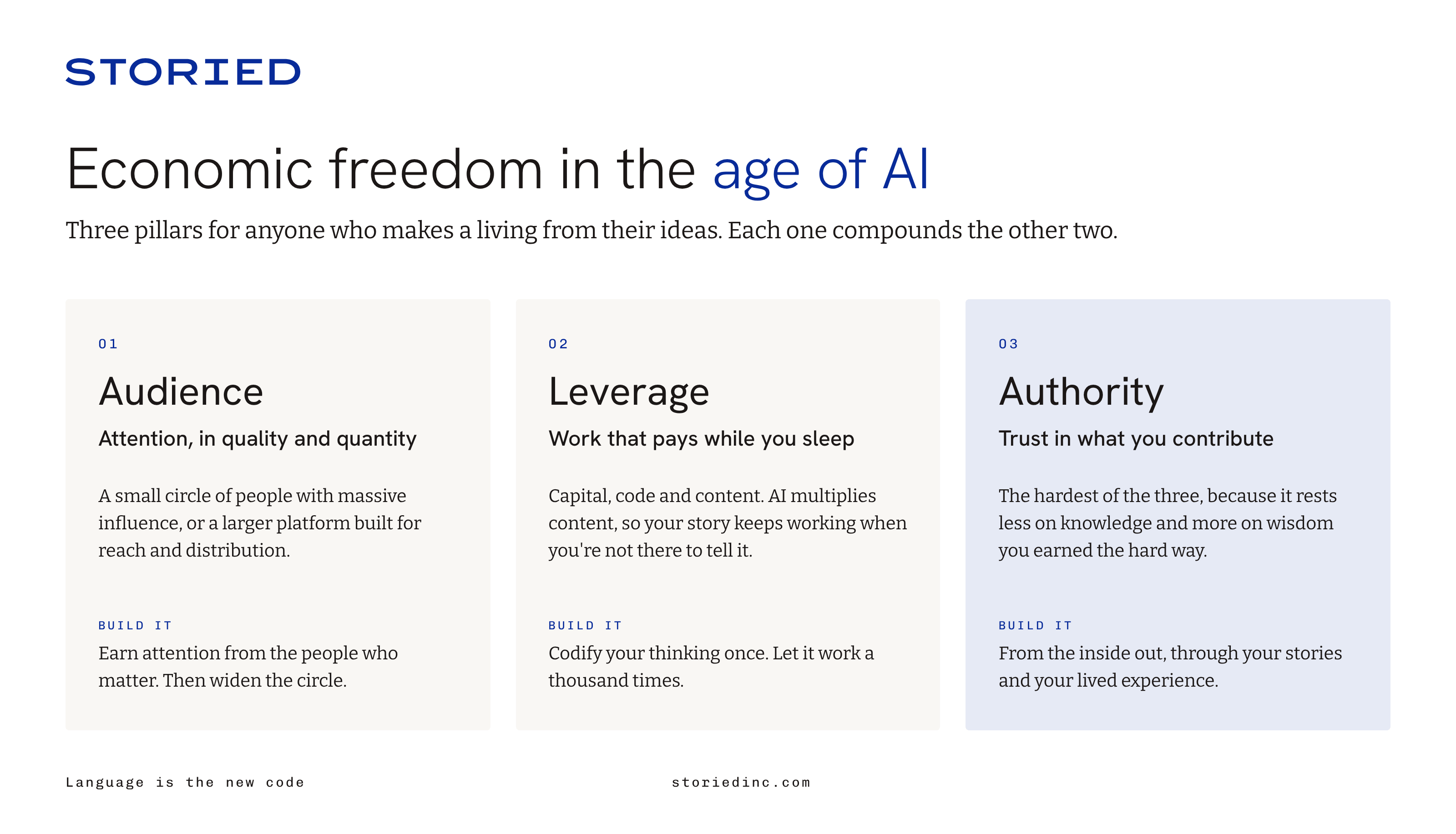
Audience is who you reach or have a relationship with.
Not just quantity, but quality. You might have a small audience composed of people with massive influence, or you might build a larger platform for distribution. If your 2,000 LinkedIn followers include the 30 people who hire, refer and introduce in your market, that’s a stronger audience than 50,000 strangers. It’s an influence graph, not a follower count. Attention is the asset.Leverage is work that pays while you sleep.
Borrowing from Naval Ravikant, I think of three kinds: capital, code and content. Financial leverage is compound interest. Tech leverage is software code, the 0s and 1s. Storytelling leverage is media or content: the ability for people to experience your story without you there. See why AI is a force multiplier?Authority is whether people trust what you have to share.
It’s the hardest of the three pillars, because it’s based less and less on knowledge and more and more on wisdom. That means it has to come from the inside out, from your stories. It’s also what keeps you from being interchangeable when AI makes everyone’s output look the same.
All of this now compounds:
Audience without authority is someone who won’t get taken seriously.
Authority without leverage is capped by the number of hours in your day.
Leverage without audience is a great product without enough distribution.
Anything you codify once can now work for you a thousand times.
Most people over-invest in one pillar and starve the other two. Look at where your last 90 days went, and you’ll likely see which is which.
Authority is the pillar people often wait for someone else to grant to them.
Where Your Authority Comes From
There are four kinds of authority, and it’s worth taking stock of how much you have of each.
When someone decides whether to trust you, they’re reading signals, most of them before you say a word. Two kinds come from outside you, and two work more from the inside out.
Borrowed Authority: the reputation and stature of others
Positional Authority: the seat you hold, and the power assigned to it
Earned Authority: the track record that can be independently verified
Natural Authority: the authentic story of who you were born to be
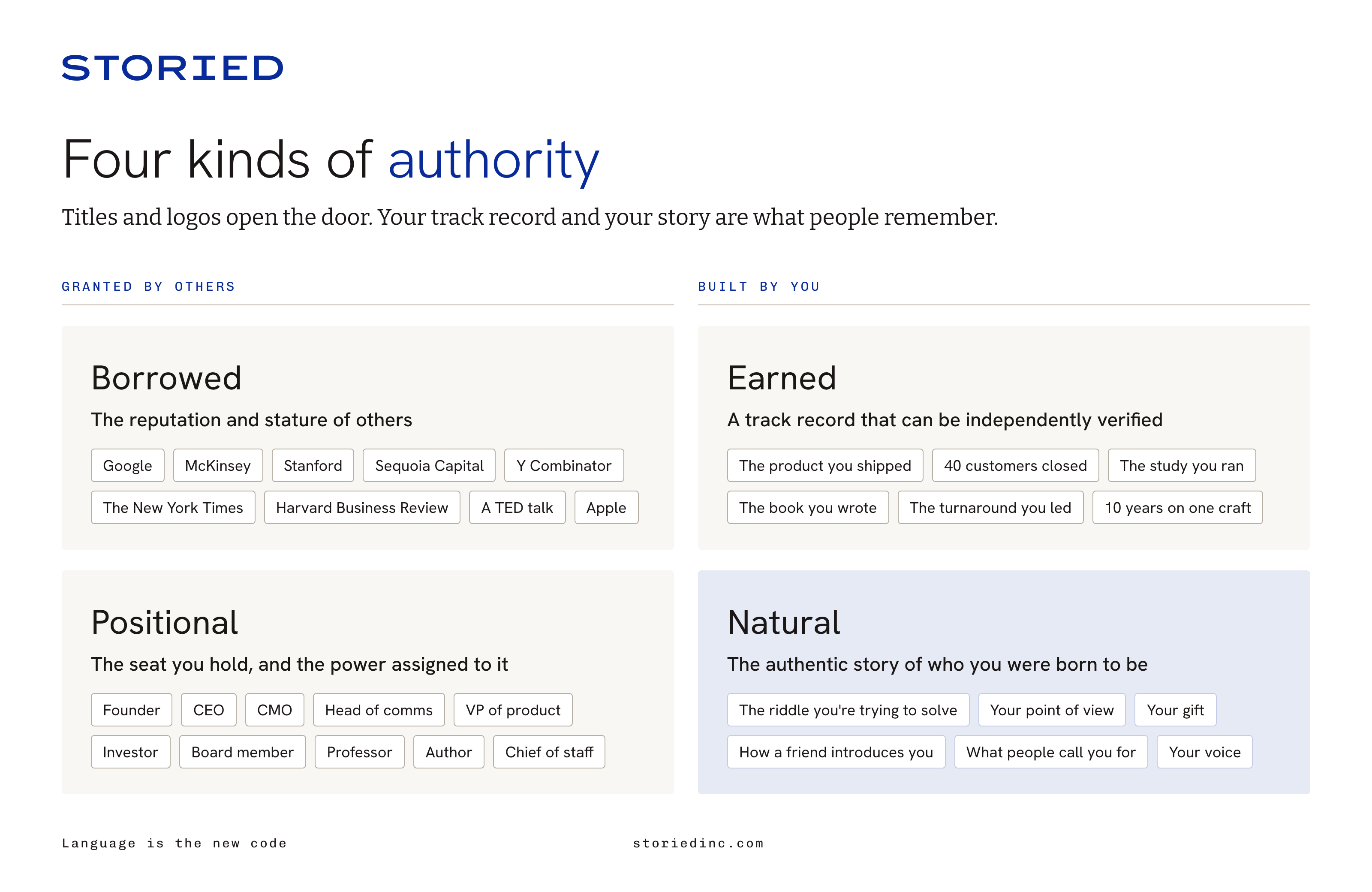
Borrowed Authority looks like Google, McKinsey, Apple, Stanford or Y Combinator on your résumé, Sequoia Capital on your cap table, a New York Times feature, a Harvard Business Review byline, a TED talk. It anchors something new in something familiar, which is why it opens the first door. The risk is being eclipsed: the name gets the credit, and you become a footnote in your own story. Power is outside yourself.
Positional Authority looks like founder, CEO, CMO, head of comms, chief of staff, VP of product, investor, board member, professor, author. It tells people how to treat you before you speak. It also lasts as long as the seat does, and a reorg, an acquisition or a reputational crisis can diminish its value over time. Again, power is externally referenced.
Earned Authority looks like the product you shipped and the numbers behind it. The 40 customers you closed. The 200 issues of your newsletter, the study you ran, the book you wrote, the turnaround you led, the 10 years you spent mastering one craft. It answers the question every skeptic is asking: what gives you the right? This is internally sourced.
Natural Authority looks like your point of view, your gift, your voice, the riddle you’re trying to solve, what people call you for. The colleague everyone calls before a hard conversation. The engineer who can explain the system to the board. The storyteller who sees what a company is really about in the first 10 minutes. This is what no one can steal or take away from you.
Right now I’m working with the founders of a new private investment fund. No surprise, they have lots of elite Borrowed Authority and Positional Authority: marquee firms on their résumés, senior titles, track record. Yet they don’t want to play it safe. They want to be known as contrarian thinkers who plant a flag and challenge conventions. That takes Natural Authority. So instead of hiding behind their credentials, they’re articulating their investment thesis in ways that are controversial yet defensible, and built to start a serious debate. That takes courage and conviction. Or as I like to say: character trumps credentials.
Look at the first line of your LinkedIn About section or your speaker bio. If it opens with a former employer and a title, the reader meets the external validator before they meet you. Try flipping it. Open with something that’s truly you, back it with one result, and let one borrowed name sit low.
Stop Waiting for Permission
Narrative Intelligence® starts with how you think about how you think.
At Storied we think a lot about metacognition. And it’s why the work of Robert Kegan and Lisa Lahey, preeminent developmental psychologists at Harvard University, sits underneath everything we build. Kegan and Lahey spent decades mapping how adults grow, develop, and become world-class leaders.
Kegan describes five Theories of Mind. The move that matters most is from Order 3, the Socialized Mind, to Order 4, the Self-Authoring Mind. By Kegan’s own research, more than half of adults (58%) never fully take the leap. The difference is where Natural Authority resides.
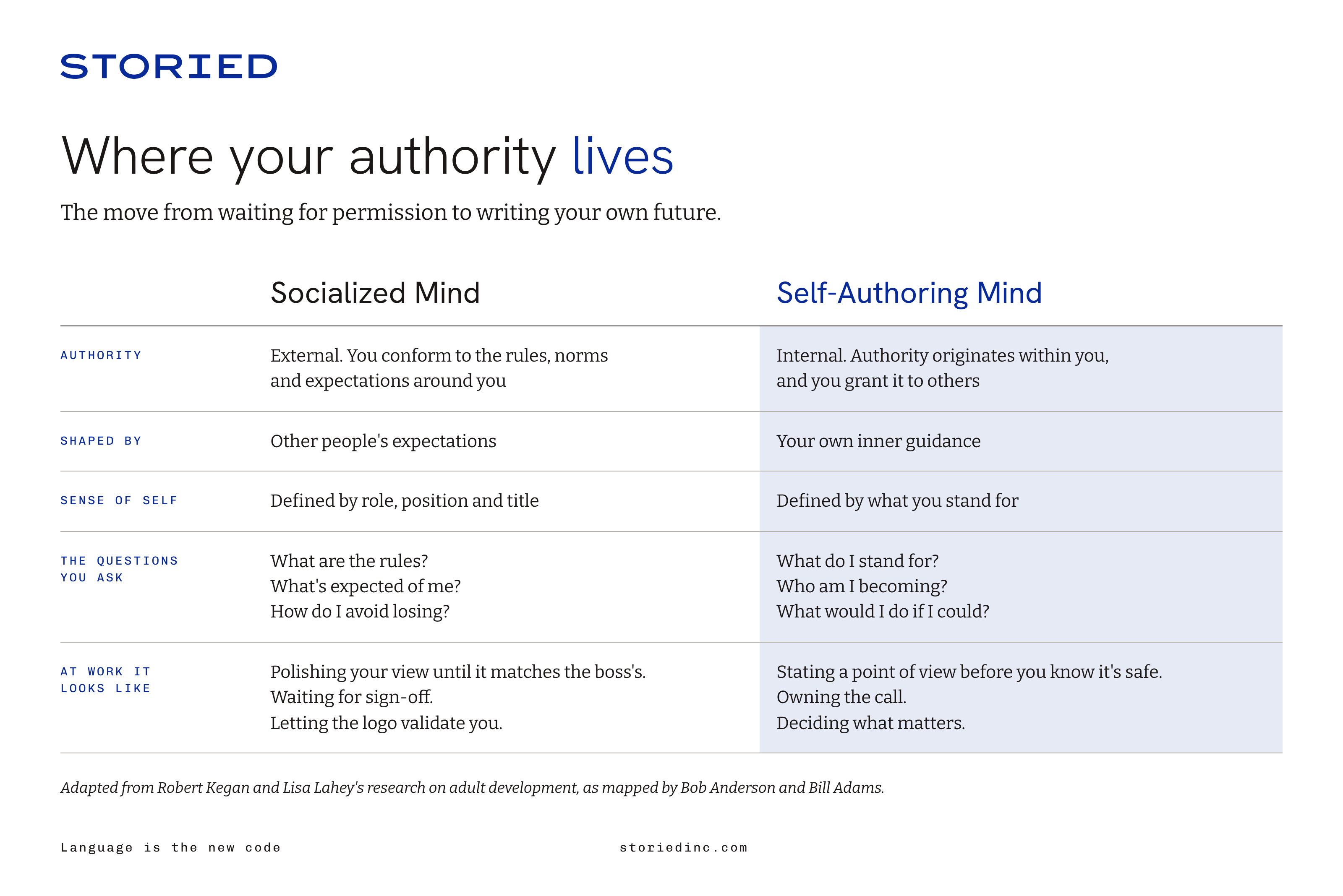
In the Socialized Mind, authority is external. At work, it looks like polishing your point of view until it matches the boss’s, waiting for sign-off, and letting the logo validate you.
In the Self-Authoring Mind, authority originates within. At work, it looks like stating a point of view before you know it’s safe, owning the call, and deciding what matters. Kegan named that capacity self-authorship, a “shift of meaning-making capacity from outside the self to inside the self.” Personally, I think it’s the hidden secret to unlocking the value of AI.
So which mind are you living in?
Think about the last time you had a strong point of view in a meeting. Did you say it, or did you wait to see where the most senior person landed?
Borrowed and Positional Authority keep you in the Socialized Mind.
Natural and Earned Authority are how you move into the Self-Authoring Mind.
Self-authoring is also the path of least permission.
When you tap into Natural Authority, it doesn’t require permission from others. It simply demands being relevant enough that people want to pay attention.
As the saying goes: Power is never given. It must be claimed.
How AI Multiplies Your Authority
If you’re worried AI will take your authorship, you’re not alone.
AI writes fluently, fast and nearly free, so it’s easy to conclude that writing, and the authority that came with it, is being commoditized.
That’s true of the words. It isn’t true of the author.
Steve Jobs called the computer “a bicycle for the mind.” Think about a trip of 100 miles. You can walk, run, bike, drive, or fly. The destination is the same. The vehicle decides how fast you get there and how far you can go. AI is the fastest vehicle we’ve ever had. It still needs a driver who knows where to go.
For an author, AI organizes your thinking, finds the patterns across years of your work, and connects dots you didn’t know were related. It amplifies whatever you bring. Bring nothing, and it amplifies the vanilla beige, boring middle. That’s what AI slop is. Nothing distinct or original.
Most people try to fix this with better prompts. The real fix is a narrative harness: a set of files with your stories, your point of view and how you see the world, loaded into every conversation so Claude or ChatGPT works from you instead of the internet’s average. I wrote the full breakdown in The Narrative Harness: Why Your AI Doesn’t Sound Like You. Your harness amplifies self-authorship, it just has to be structured into a format that is machine readable, for AI agents to follow.
With a narrative harness, your voice gets distinct and durable, and you become trusted authority that provides signal amidst the noise.
This Newsletter Is the Prompt
Copy this whole issue into Claude or ChatGPT.
Then paste this underneath and run it:
Using the newsletter above as your framework, infer from the exhaust of my behavior, and everything you know about me, plus my LinkedIn profile and professional bio, and rate me from 1 to 10 on borrowed, positional, earned and natural authority. Tell me which one I lean on most. Then ask me 5 provocative questions, one at a time, that would help me reveal and express my natural authority. When we’re done, write my natural authority in one line and one paragraph a friend might use to introduce me.
Once you’re done with the exercise, save this output to memory.
You are now one small step closer to a narrative harness.
What I’m Opening Next Week
I’ve spent four years rebuilding my work for the age of AI.
AI can make you sound like everyone, or it can make you sound like you.
The difference is whether it knows your stories, your judgment and your point of view. In a manner that compounds your authority, influence, and success.
Next week, I’ll walk you through a new signature offering I’ve been building. It answers the two questions I hear most right now. How do you get AI to sound like you and think like you, so it’s a trusted extension of you? And how do you get it to carry your authority, so you can compete in the new AI economy?
It’s for anyone who wants to go from storyteller to Narrative Architect.
The whole thing runs on 50+ Narrative Intelligence® skills. That’s 25 years of everything I know about getting ideas funded, bought and believed in. Codified so AI can put it to work for you. It’s also the method for training AI on your stories and judgment, so it becomes a bicycle for your mind, if not a 🚀.
In the meantime, run the prompt above. Discover which kind of authority you lean on most, and which one you’ve been leaving on the table.
Michael
P.S. Become a Certified Narrative Architect.
Enrollment opens December 1. Join the early release list.
Okay, I did the Claude thing, here ya go:
Your natural authority
In one line:
Todd E Jones digs up the true story a business already has, with the scenes, the people and the why, and won't let anyone flatten it into a timeline or squeeze it into a marketing template.
The way a friend would introduce you:
"You need to meet Todd. He's out of Conway, Arkansas. He studied theology and wandered into sports writing, so he treats a company's story as something sacred that also has to be true. That's rarer than it sounds. Most B2B and small companies have been told brand storytelling is for the big guys, so their About page reads like a résumé and their marketing reads like a Mad Lib. Todd sits down with you and finds the actual scenes: who was in the room, what went wrong, why you kept going. Then he turns that into stuff that keeps working long after the 90-day campaign crowd has moved on. He'll also tell you to your face when your story's gone vague. He's the guy who makes sure people remember you after you leave the room."