


An 8-minute read on the Narrative Harness: the part of your AI that determines whether it sounds like you.
Anyone building with AI has tried the obvious fixes: a newer model, a bigger context window, a fourth rewrite of the prompt. The output got smarter and still sounded like everyone else, because everyone rents the same models. What's different is everything around the model.
The formula AI engineers use: Agent = Model + Harness.
The large language model (LLM) is the brain you rent. The harness is everything you wrap around it: the binder every new hire gets in week one, plus the editor who reads their draft before it goes out. I'd argue the harness now decides more about whether AI works for you than the model does.
Your AI already runs on a narrative harness. You just didn't write it.
The Anatomy of a Narrative Harness
Most of an AI harness is plumbing you or your engineers already build: tools, permissions, and runtime.
The Narrative Harness is the part that holds meaning: what you believe, the words you use, how you sound, and the checks that hold your AI to all three.
It runs at three altitudes:
At thesis, the CEO writes and ratifies strategy, worldview and big bets
At execution, functional heads define words, decision rules, and sign-off
At encoding, whoever runs AI infra turns it into one system of record every tool reads
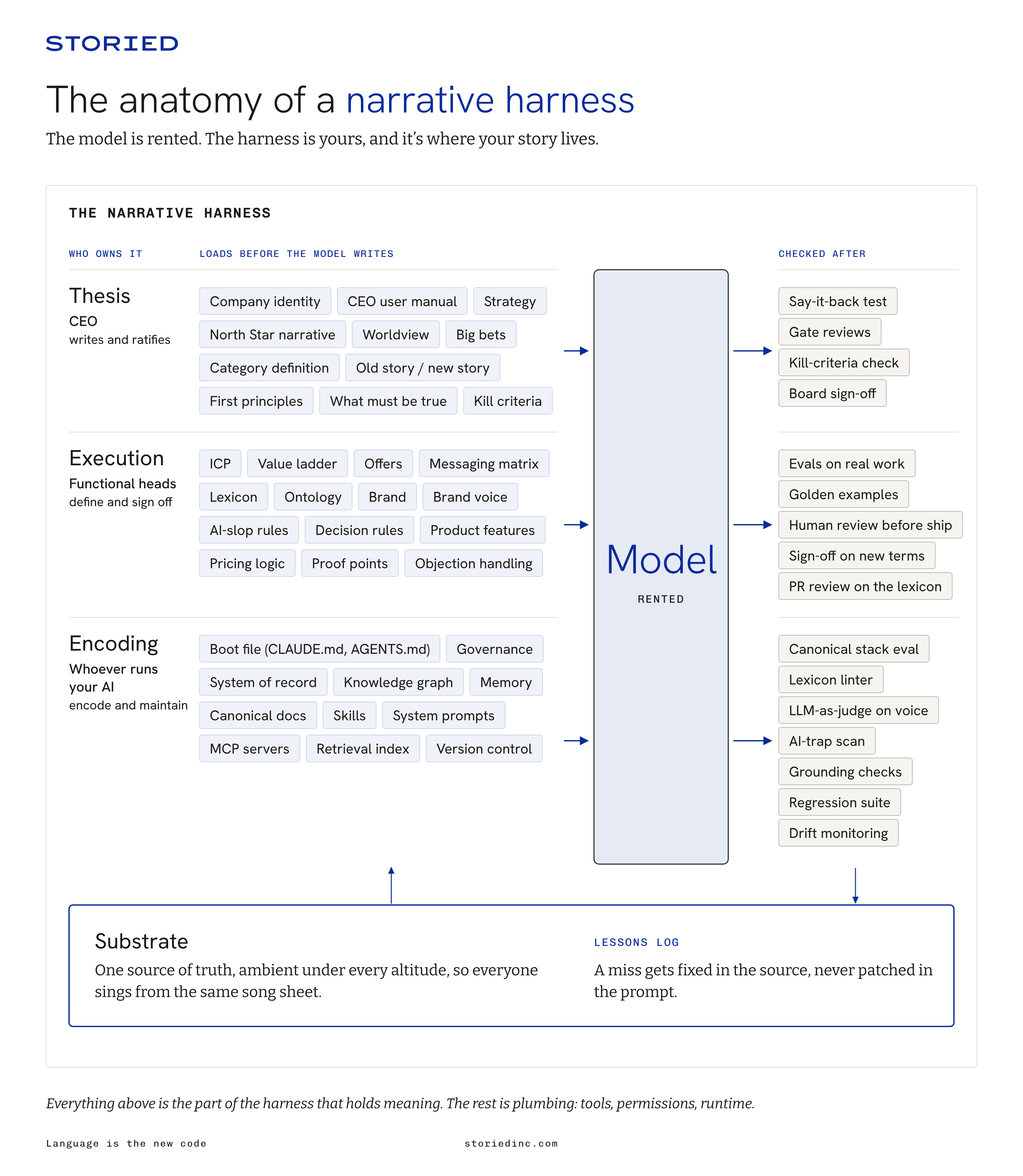
Let’s follow one decision down this waterfall:
At thesis, the CEO rules that the company sells a platform to the mid-market. At execution, the head of product marketing writes it into the lexicon map: the product is a "platform," never a "tool," a "solution" or an "app." At encoding, that ruling lands in one versioned file every agent loads before it writes, and a linter, a check that runs on every draft, flags "tool" before it ships.
Under all three sits the substrate: one source of truth, ambient in the background, raising the floor so everyone's singing from the same song sheet. When a draft comes back saying "tool," the fix goes into the source, never into one more prompt.
What Your Context Layer Can't Tell Your AI
In October McKinsey told CEOs to build an AI operating system.
They said: "Own the context; rent or replace the technology."
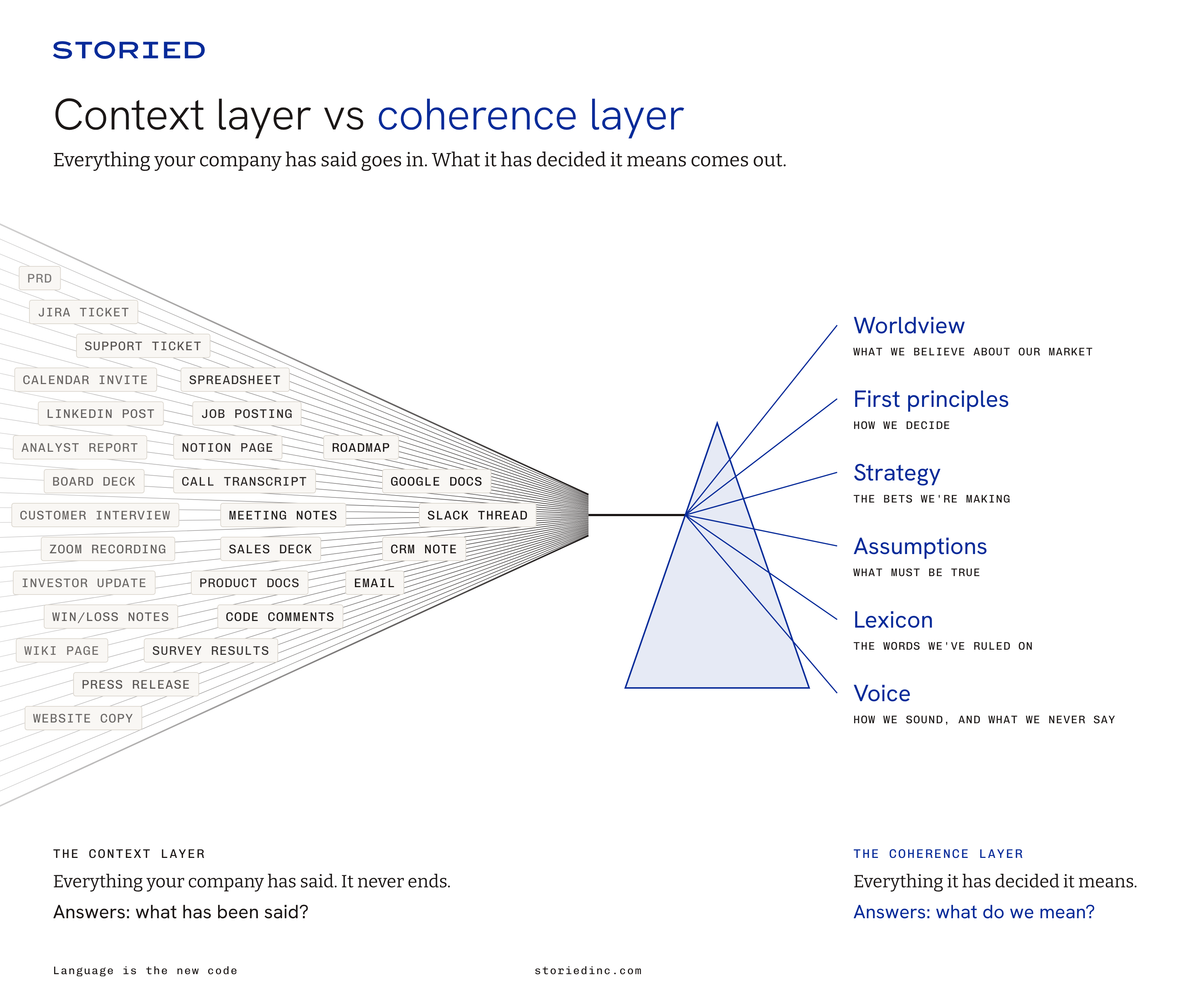
They're right that every company needs a context layer: every email, Slack thread, doc and call transcript, piped in and searchable. It just isn't enough.
Watch what that does to one noun. Sales' AI calls your product a platform. Product's AI calls it a tool. The board deck calls it a solution, and the onboarding emails call it an app.
Your CEO did decide, once, in a leadership meeting in January: it's a platform. Your AI has seen "tool" 4,000 times across your Slack and your docs. Guess which one it writes.
The coherence layer holds every ruling like that, everything your company has decided it means: your worldview, your first principles, the words that mean something specific here, and how you sound. That part usually gets left to whoever happens to write the prompt that day.
I call it language debt. It's only gotten more expensive since I wrote about it.
Language debt is the new technical debt.
It compounds the same way. Every word nobody ruled on taxes alignment a little more each time it gets copied, and AI made the copying free.
That’s because AI amplifies clarity, and AI amplifies confusion. It chews through all language left unattended.
The cleanest evidence comes from Anthropic's own data team. Giving Claude raw retrieval access to thousands of prior queries moved accuracy on their analytics evals by less than a percentage point.
Writing the domain down, in plain reference files that say what each table covers, which filters apply and what the domain means in plain words, took accuracy from no better than 21% to above 95%. Their rule: let Claude write the documentation, and have "a human own the definition."
Metrics are the easy case. A revenue number has only one right answer. Your strategy and your voice have dozens of plausible ones, and a model with nothing to rule between them picks the average.
Five Words Every Narrative Harness Runs On
These five are what engineers talk about for making AI reliable.
You don't have to build any of them. You do have to know what they mean, because each one is a decision your company either made or left to chance.
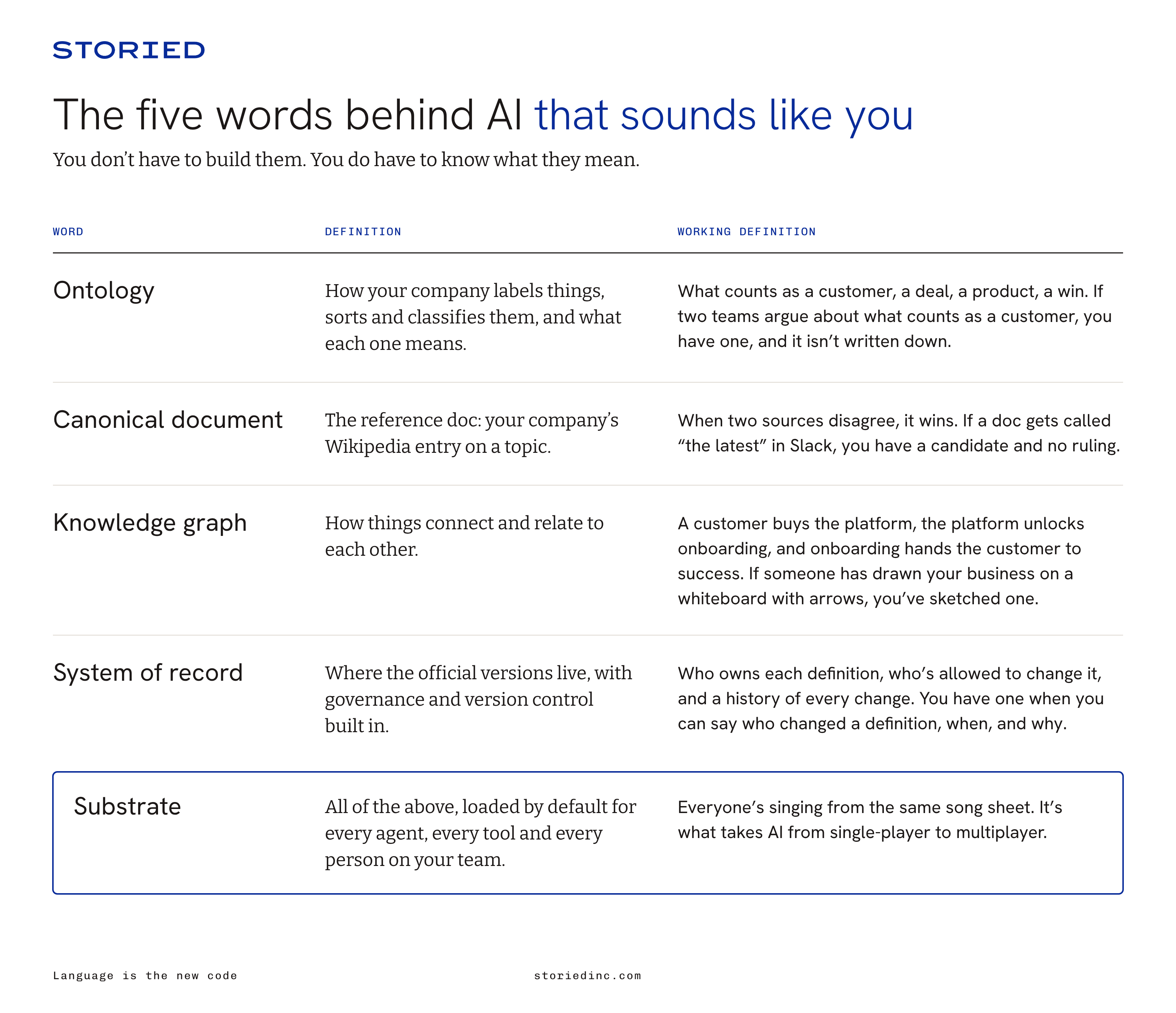
AI can draft most of this. Nimit Mehta, who runs the ontology company TopQuadrant, put it plainly: "AI can take you from zero to eighty percent of an ontology faster than ever before... The last twenty percent is where it goes south, because that is where humans have to sit in a room and agree."
A Narrative Harness in the Wild
We built our own narrative infrastructure first.
Over the last 18 months, Storied's narrative harness grew into 14 git repos: Internal OS (our worldview, methods and voice rules), Content Flywheel (how we make content), our skills directory, the Storied AI MCP server and the services around it, and a few public GitHub repos anyone can install.
After being quiet in stealth about this, I’m now publishing what we’re learning.
Our Internal OS alone holds about 2,000 files, including philosophy, first principles, words we've banned and the AI tells we check for. 50+ Narrative Intelligence skills run on top of it, and about 500 commits since May show who changed which rule, when and why. Every draft that leaves Storied, this issue included, is written on that harness and checked against it after. With lots of human chiseling and editing in between.
When Ameno, our AI Platform Architect, first walked through it, his reaction was "holy #$%#$!" He'd expected brand guidelines. He found an ontology for strategy and business decision-making. This led to our Storied AI MCP.
The same narrative harness work is now part of how we partner with clients:
A regulated science company. As AI agents start running parts of the science, the people who own compliance have become part of the harness. They’re the confidence and compliance layer for agentic science.
An enterprise software company mid-disruption. Its category was breaking and its GTM is being rebuilt around agentic products. The harness holds one meaning for what the company is while everything around it moves.
A philanthropic venture fund raising $100M+. Its investors range from Silicon Valley tech to conservative business leaders. The harness carries the overall conviction across multiple worldviews, and translates the pitch into the language of love for each ultra-high net worth individual.
They’ve all built the antidote:
A company that has decided what it means, and its AI won't let anyone forget it.
Who Owns Your Narrative Harness?
My call: by the end of 2027, companies running AI at scale will have a named owner of their narrative harness, and "who owns it" will be a standing line in AI governance reviews, next to data access and model risk.
Don’t worry, you can also build a narrative harness at the n=1. Just simply for your own single-player use to advance your career, ideas, and influence.
The data world was the first to realize ontology is everything.
Anthropic's rule, a human owns the definition, already reads like a job description. “Who owns meaning” comes next, and its ownership splits the way the harness does: the CEO owns the conviction, functional heads own the working definitions, and a tech operator owns the system of record.
Palantir built a public company on the concept of ontology. Its docs describe its Ontology as "a digital twin of the organization," built "to facilitate better decision-making in an organization at scale." In the second quarter of 2026, its US commercial revenue grew 149% year over year. Whoever holds the ontology holds what the company means. The question for you is whether yours lives inside a vendor's platform or in a repo you own.
Every narrative harness also needs someone who holds the whole of it: that's the role of the Narrative Architect.
Maybe bigger context windows make all of this moot. I'm betting they won't.
Ten Minutes to See the Harness You're Running On
Run this audit on Monday.
It will take 10 min. It walks three questions: what loads before your AI writes, who rules on it, and what checks it after.
See what loads. Paste this into the AI that knows your work best:
Write out the narrative harness you currently use when you write about my company, in two parts. Thesis: what we're betting on next year, what must be true for that bet to pay off, and what we believe about our market. Execution: our three first principles, the five words we use in a specific way and what each one means, how we make our most common decision, and how we sound. Mark every line with where it came from: a document I gave you, our conversations, or your own assumption about companies like ours. Be blunt about the assumptions.Rule on it. Send the result to two people on your leadership team with one question: is this us? Then count the lines marked "assumption." That's the part of your harness somebody else wrote.
Check it. Have three people, a functional head, a recent hire and someone who sells, each ask their own AI to explain your big bet in 100 words. If the three answers don't match, fix the source, never the prompt.
Your AI already runs on a narrative harness. Write yours.
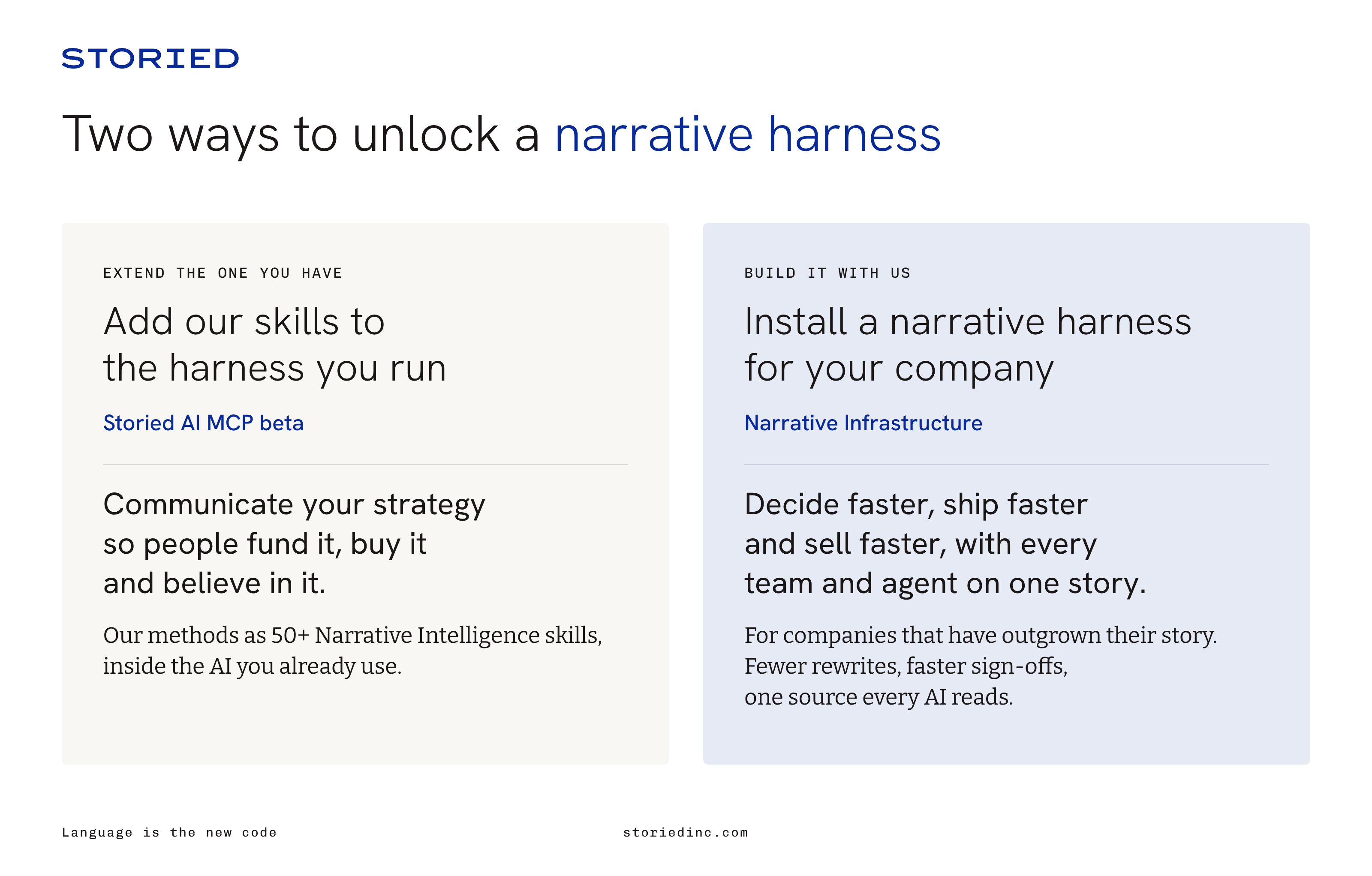
If you already have a harness or want to build one yourself, apply for access to our Storied AI MCP beta. If you want a narrative harness running across your company, that's the narrative infra work we do. Just DM me.
What do you want me to dig into next? Tell me in the comments.
Now, go own your story.
Michael
Excellent presentation of what you have been building for 18 months and what you want corporate communicators and storytellers to understand about your practice. Years ago and way before ChatGPT, you were the first to explain a new term being tossed around: ontology
I love the way you think and write. Storytelling by example. Bravo, Michael.
Agents writing for agents is the part that worries me. Nobody has to think at either end, and the six pages still look like someone did.