


The “AI conversation” has started producing a pattern I can’t ignore.
In nearly every room I’ve been in lately, whether it’s a boardroom, a keynote, or a working session, I’m watching the same thing happen.
Someone brings up AI and the room subtly splits. Not into believers and skeptics.
Into two groups who are both right.
One group – sees momentum. Real applications, real traction, a window that’s opening. The other group – sees the gap. The structured data problem, the regulatory fog, the distance between what is promised and what’s actually currently delivered.
Both are making rational calculations. They’re just standing in different places.
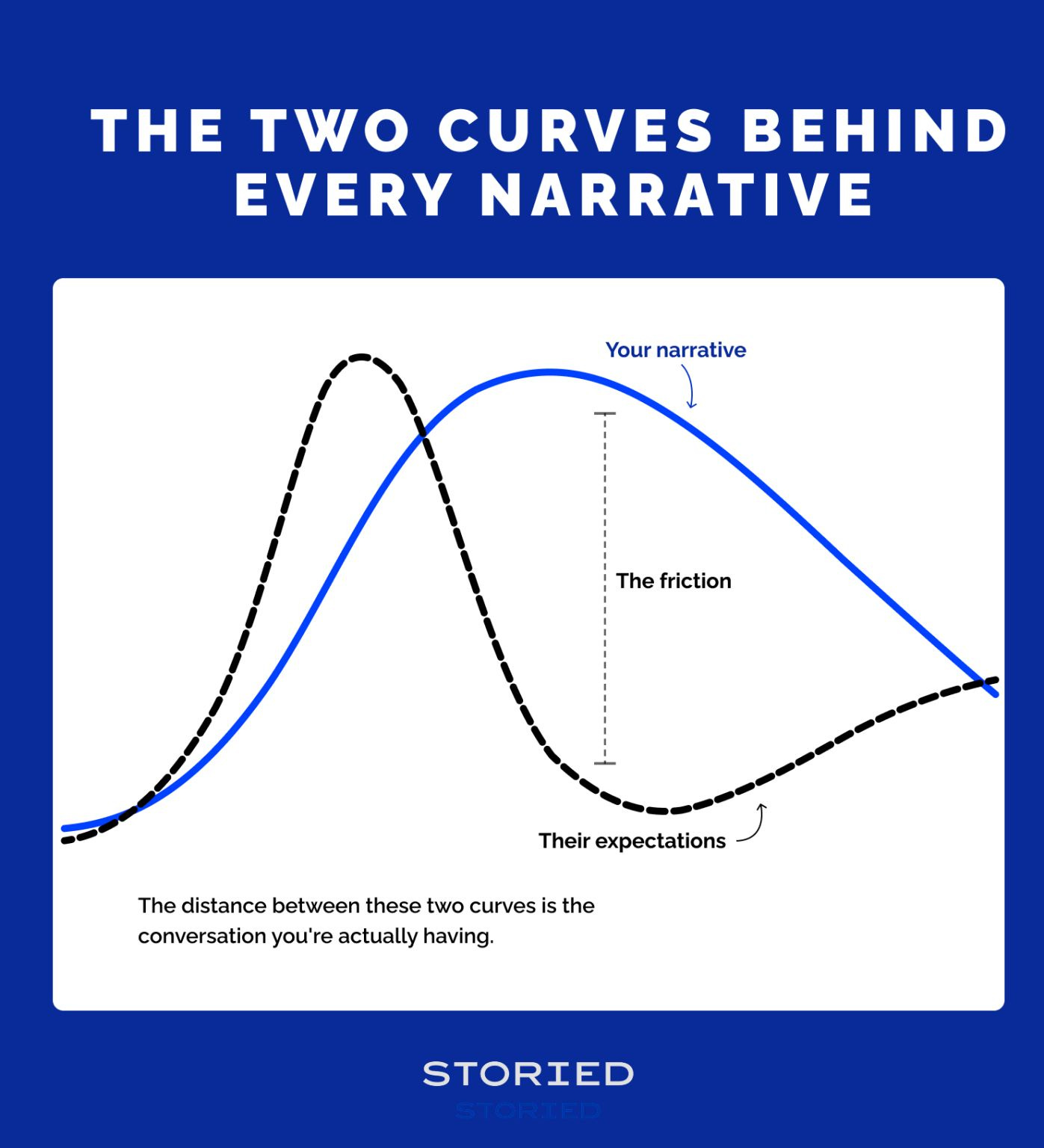
Curve 1: The Lifecycle of Your Narrative
Every narrative has its own lifecycle or s-curve.
Early on, a new narrative acts as a force multiplier. It’s novel, energizing, ahead of the room. People lean in because the idea feels like it’s opening something new. Over time, it matures and stabilizes. It becomes familiar and expected. And eventually, if you’re not careful, it becomes a drag. Familiar. Expected. No longer opening anything.
Where your narrative sits on that arc shapes what it can do.
But that alone doesn’t explain why the same story accelerates one room and slows another.
For that, you have to look at the second curve.
Curve 2: The Hype Cycle of Expectations
Every major technology wave follows a predictable pattern.
The Gartner Group calls it the Hype Cycle.
Excitement spikes. Capital floods in. But quickly the narrative outruns reality. Then disillusionment sets in, not because the technology failed, but because expectations ran ahead of adoption. Over time, substance compounds and the signal stabilizes.
AI is living inside that pattern right now. The excitement is real. So is the fatigue.
That fatigue has a cost. It shows up in skepticism: longer sales cycles, tighter budgets, more pilots, more governance layers, more requests for proof before commitment.
Not because the future isn’t coming. Because belief capacity has shifted.
Where the Curves Collide
A few weeks ago, I spoke to an IT solution provider that works with US government agencies.
It was their annual sales kickoff, with a room of 300 sales and technical consultants.
Everyone in the room knows the future is here.
Quantum risk is real. AI is reshaping the flow of work. The tension wasn’t conviction. It was timing.
Their buyers are living in two horizons at once. Today’s compliance constraints and legacy systems. Tomorrow’s inevitabilities in quantum and AI. Agencies have lived through modernization cycles that overpromised. Large IT transformations that failed to compound. Budget allocations framed as inevitable that did not return velocity.
That history shapes interpretation. It shapes how much future they are willing to buy today.
If you lead only with inevitability, you sound like the last wave. If you lead only with present constraints, you undersell the structural shift underway. The work is helping buyers move along the S-curve while acknowledging where they are on the Hype Cycle. Acknowledging current reality. Naming the inflection point ahead. Giving them language to allocate belief proportionally instead of defensively.
You cannot move people forward until you acknowledge where they’ve been.
When the lifecycle of your narrative and the expectation position of your audience align, velocity increases. When they don’t, friction compounds. Not because the story is weak, but because the posture is miscalibrated.
The Essential Diagnostic
Before your next strategic conversation, ask yourself two questions:
First: where is your narrative on its lifecycle?
Still a force multiplier. Now in proof mode. Quietly becoming familiar. And where is this audience on the hype cycle? On the upswing. In the trough. Past the noise and rebuilding trust.
Second: what narrative debt are they carrying?
Have they absorbed failed pilots, overpromised transformations, budget overruns framed as inevitabilities. That fatigue has a cost. It’s when a board that was ready to approve the rollout asks for another pilot instead.
Most teams map their message. Few map the psychological position of the room.
Belief allocation. That’s where velocity is won or lost.
This isn’t really about two curves. It’s about timing, trust, and how much future your audience can absorb right now.
Where are you standing.
And where are they.