


Every AI agent your company deploys runs on language.
The instructions you give it are language. The definition of your ideal customer is language. What your company stands for is language. What counts as a good outcome, and what counts as a bad one, is language. The category your whole business is playing in is language.
All of it is language. And probably nobody in your company owns whether it all says the same thing.
When agents are doing thousands of things a day on your behalf, at machine speed, this problem won’t stay small for long.
Aaron Levie, CEO of Box, wrote a post on LinkedIn this week that pointed at half of this problem. He spent a week on the road with a couple dozen IT and AI leaders across banking, media, retail, healthcare, tech, and sports. He outlined the role every one of those enterprises is now racing to hire. This is AI transformation at the agentic level.
He calls it the Agent Operator.
The person who takes a messy human workflow, redesigns it for AI, and sets up the agents that actually do the work. Probably one or more per team. Possibly the most important role your company is hiring for in 2026.
Here’s a diagram of what this new role looks like:
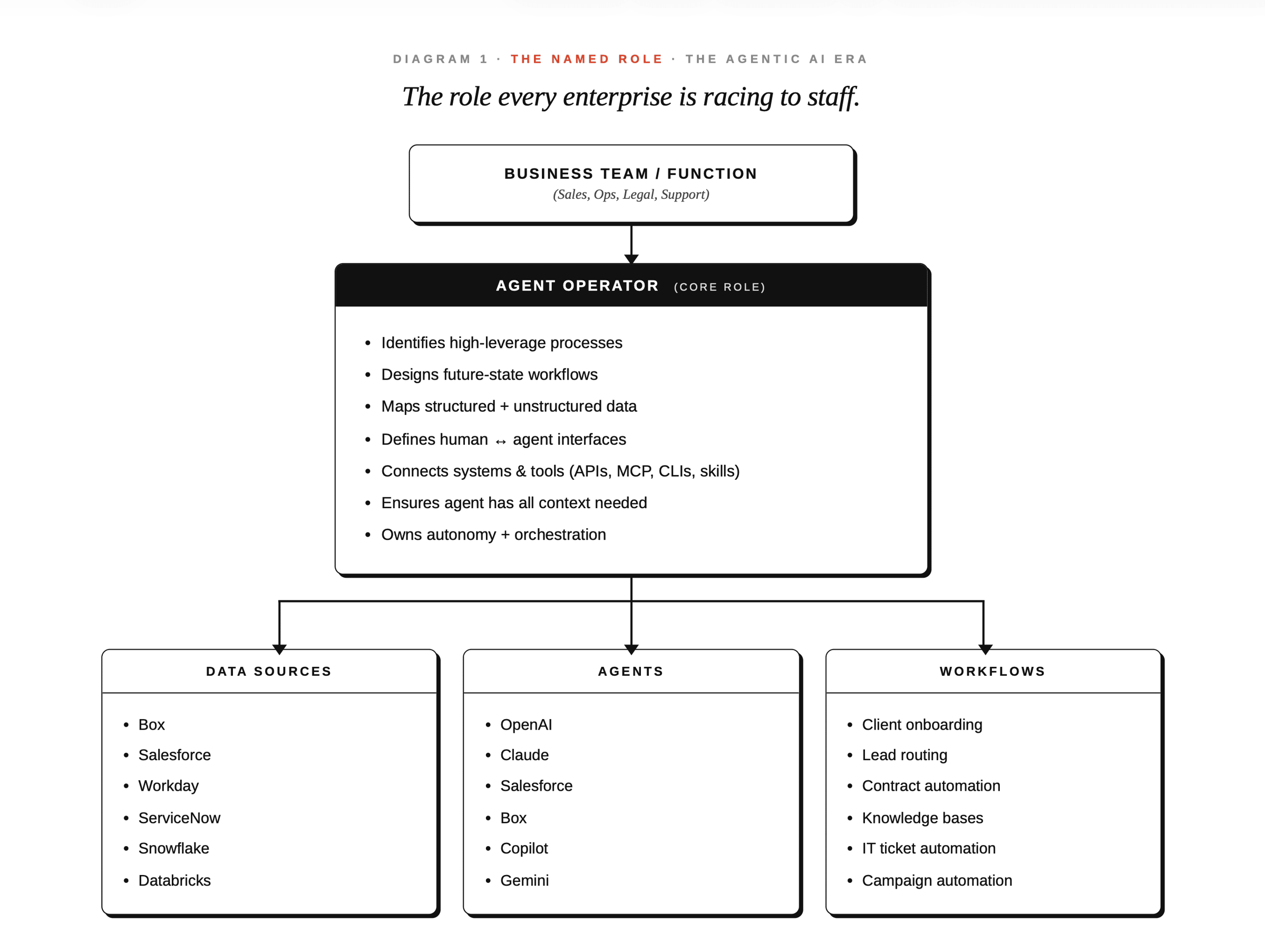
Aaron Levie is right. Every enterprise I’m walking into is trying to staff this role right now, whether they call it that or not.
But the Agent Operator is only half the role the agentic era actually needs. There’s a second role. That even fewer are staffing for yet. Yet without it, every agent the Agent Operator ships is at risk of compounding a problem instead of solving one.
Narrative Architect: the new role nobody is naming
The Agent Operator sits inside a team.
Sales. Ops. Support. CS. Their job is to take one workflow in one function and make it work with AI.
That’s useful work. But nobody doing that job is looking up from their team to ask whether the language their agent is using matches the language every other agent in the company is using. That’s not their scope. It shouldn’t be.
Somebody above the team has to own that. Somebody whose job is the words underneath everything. The category you claim to be playing in. The language for what you sell, who you sell it to, and why it matters. The story every agent, every rep, every deck is pulling from.
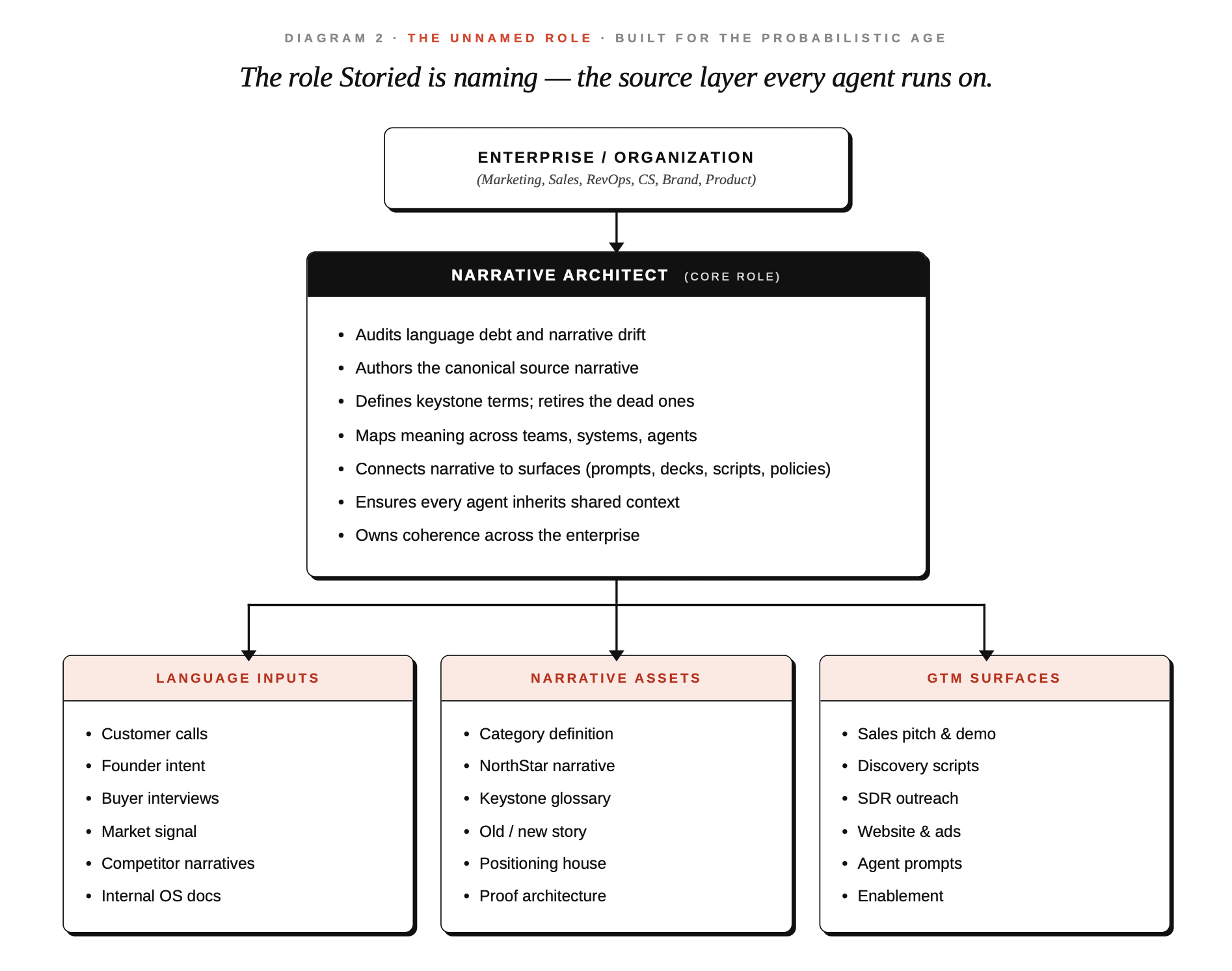
Call it the Narrative Architect. One per enterprise, not one per team.
The Agent Operator builds the agents. The Narrative Architect owns the language system those agents run on. You need both.
The layer that 99% of enterprises aren’t seeing yet. Here’s a 2nd diagram for you:
Why this is a new role, not an old one dressed up
Most companies already have people who “own the words.”
Chief Marketing Officers. Comms leads. Sales enablement. Brand directors. Content strategists. Six roles, sometimes more, with some version of language in the job description.
The pushback is usually some version of: don’t we already have that?
The answer is no. And the reason is the difference between a role you can rename and a role you actually have to build.
In the old world, language drifted quietly in hallway conversations.
A sales rep would hear something on a customer call and translate it into the deck. A product manager would hear something in a roadmap meeting and translate it into the spec. A CMO would hear something at a board meeting and translate it into the blog post. Humans absorbed the drift. Humans did the translating. The cost got paid in meetings, over months.
In a world of AI agents, nobody is translating. Agents don’t translate.
They run on whatever language they’re handed. Thousands of times a day. In parallel. At machine speed.
So when your sales AI, your support bot, your website, and three different prompt libraries are all running on slightly different versions of the same story, you don’t get drift. You get the game of telephone, amplified at the speed of AI. Every customer sees a slightly different company. Every employee learns a slightly different strategy. Every deal gets qualified against a slightly different buyer.
The old brand and comms roles were designed for a world where humans made up for the gaps in the language. That world is ending. The new role has to build the language so there are no gaps to make up for.
That’s a different job. It takes a different mind.
I’ve written previously about language debt. The accumulated cost of every undefined term and every vague commitment your company carries. It used to accrue slowly. Now it compounds every time an agent runs.
Your AI rollout doesn’t fix your language problem. It distributes it at scale.
The game underneath the game
That’s the gap Aaron Levie’s LI post didn’t name. Not because he’s wrong about the Agent Operator. He isn’t. It’s that the role he described assumes the language is already clear. In most companies, it isn’t.
The category of the agentic era isn’t going to be won by the company with the best model, the best agents, or the most content. It will be won by the company whose language holds under load. Words used to be the soft part of business. They’re about to become the hard part. Every enterprise is about to find out whether their language scales or fractures. Whoever builds the role that decides which, wins.
Over the next 18 months, two things will start happening in parallel.
A handful of companies begin staffing this role, quietly, usually reporting to the CEO or the CMO. And the companies that don’t will start to feel a friction they can’t diagnose. Slower pipeline velocity. Customer confusion that doesn’t trace to a single cause. AI rollouts that technically shipped but didn’t move the numbers.
The first group won’t brag about the role. They’ll just start to pull away.
So here’s the question I’d leave you with this week.
If your language is going to run a thousand agents in two years, what would it take for that language to be sound at the scale of running a thousand agents?
Not good enough. Not clear enough. Sound.
That’s a different bar. And it’s the bar the next decade is going to demand.
Until next week,
Michael