


A few years ago, during a Q&A after a talk, someone asked me a question I couldn’t shake:
“Is what you’re talking about similar to Aristotle’s Three Proofs of Rhetoric?”
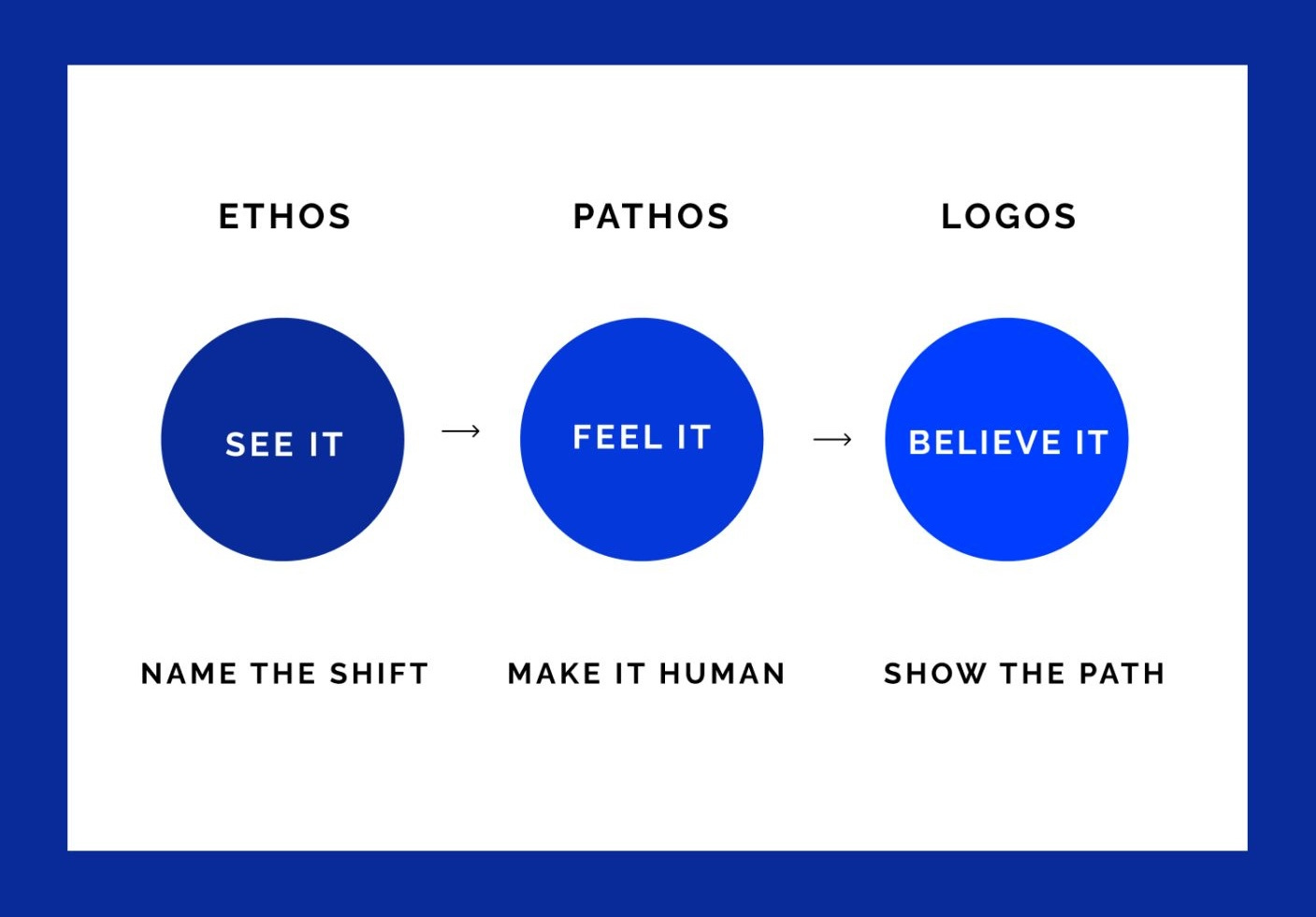
I’d been sharing my narrative framework See It, Feel It, Believe It - a signature sequence I developed for execs and founders trying to sell a future that didn’t yet have permission to exist. This person in the audience wanted to know if I was copying something a Greek philosopher figured out two thousand years ago.
I hadn’t thought about Aristotle since junior year of college. But the question stayed with me, so I went back and looked.
Ethos. Pathos. Logos.
Oh shit.
The old man
If you’ve forgotten your philosophy class, here’s the quick version: Aristotle identified three modes of persuasion.
Ethos is credibility: why should I trust you?
Pathos is emotion: why should I care?
Logos is reason: why does this make sense?
These are the building blocks of Western rhetoric. They’ve held up for over two millennia.
And somehow, without realizing it, I’d reverse-engineered them.
See It maps to Ethos. Feel It maps to Pathos. Believe It maps to Logos.
The grab bag problem
But here’s where it gets interesting.
Most people treat Aristotle’s three proofs like a grab bag. Pull whichever one fits the situation. Lead with logic here, lean on credibility there, go for emotion when the moment calls for it.
That works fine when you’re communicating something familiar. Something where everyone in the room already agrees on the basic shape of reality.
But what about when you’re not?
What about when you’re dealing with disruption? Ambiguous problem spaces? Exponential change? A paradigm shift that challenges how people see the world?
What about when the thing you’re asking people to believe might be perceived as irrational, illogical, even heretical by current standards?
The grab bag doesn’t work.
The order becomes everything.
Why leading with evidence fails
Here’s what I’ve noticed over years of watching people try to move rooms:
When you lead with Logos (with the data, the conclusions, the proof) you’re asking people to believe something before they have any reason to. You’re imposing a conclusion. And nobody likes having belief imposed on them.
What happens? They push back. They poke holes. They become adversarial (even when your logic is airtight) because you skipped the steps that would let them receive it.
You’re over-rationalizing the narrative to death. You’re giving them Boolean choices before they’ve felt any pull toward where you’re trying to take them.
When you lead with Pathos (with the emotional appeal, the moving story, the personal testimony) you’re zooming in to an n=1. An individual moment that might be powerful but doesn’t set the broader context. It doesn’t give people the 30,000-foot view of where the world is going and why any of this matters at scale.
Without that larger frame, even the most compelling story can feel like an isolated case. Touching, maybe. But not necessarily relevant to me.
So what’s left?
Ethos. But not ethos the way it’s usually taught.
The classical interpretation of ethos is personal credibility - your credentials, your track record, why you’re qualified to speak on this. That matters, but it’s not what I mean by See It.
There’s another definition of ethos: collective motivation. The underlying values and aspirations of a group. What a culture is already moving toward, whether it’s been named or not.
This is what See It does. It names a shift that’s already underway. It captures a collective aspiration. It makes people feel like the world is moving - and that movement creates possibility, not threat.
Once people can see that shift, then they’re ready to zoom in and feel it at a human level. And only after that will they be open to believing your plan for navigating it.
See It. Feel It. Believe It.
Decision gates, where one unlocks the next.
What it looks like in practice
I was working with a VP of data science at a major tech company recently. They lead a team of brilliant data scientists - people who sit on mountains of data and have built models that would make most organizations jealous.
Their frustration? “We know everything, but we can’t communicate it.”
Their team would walk into meetings armed with evidence. Charts. Findings. Conclusions backed by rigorous analysis. And they’d walk out without decisions. Or worse - with decisions that ignored everything they’d presented.
We talked about the sequence. Instead of leading with their findings, what if they started by naming a shift in the industry that everyone in the room could feel but hadn’t articulated? What if they let people sit in that recognition before introducing any data?
They tried it with their team’s next big presentation.
They called me afterward. “They didn’t just approve the recommendation. They asked how fast we could move.”
Same team. Same data. Different sequence.
Why this matters now
Here’s what I keep coming back to.
All of this (Aristotle’s proofs, the sequence, the decision gates) matters more now than it ever has.
And the reason is AI.
We’re living through a moment where the old ways of creating clarity are being stress-tested. AI makes information abundant. It makes data accessible. It can generate arguments, summaries, and analyses faster than any human.
But it can’t do the thing that matters most: help people think about how they think.
That’s meta-cognition.
Rhetoric, at its core, is the deliberate structuring of thought so that meaning can become shared meaning. So that alignment becomes possible. So that a group of people who started in different places can arrive at a common place of understanding.
The challenge with disruption (with ambiguity, with exponential change) is that it’s really hard to find signal.
It’s hard to create coherence when the ground keeps shifting.
This is why the sequence matters. It’s not about control. It’s about coherence.
A control narrative says: here’s what you need to believe, and here’s the data that proves it.
A coherence narrative says: here’s what’s shifting, here’s what it means for us, and here’s how we might navigate it together.
One imposes. The other invites.
Aristotle gave us the ingredients. What I’ve spent twenty years learning is the sequence…and why, in a world that keeps accelerating, getting that sequence right is the difference between a room that leans in and a room that shuts down.
Michael
P.S. The old man was onto something. He just didn’t have to deal with AI.