


I was talking with a CEO a few months ago.
He runs a legacy company with decades of history and a strong market position, and after years of effort their digital transformation is finally working. By most external measures, they are winning.
About halfway through our coffee, the energy shifted. He put his mug down and said:
“I finally feel like we’re good at this. I can see the path to victory. But I have this nagging sense that we’re about to get T-boned in five years by AI. Not a collision. An extinction event.”
That line has been stuck in my head.
I hear versions of it all the time. Different industries, different leaders, but the same underlying sensation. The story that got us here worked, sometimes remarkably well, and yet something about the room now feels different.
The question that usually follows is practical.
“How do we fix our messaging?”
But when a leader feels that particular mix of clarity and unease, it is rarely about the words themselves. What they are sensing has much more to do with trajectory than expression.
It is not a messaging problem. It is a curve problem.
Growth has a shape
To understand why a story stops working, you have to look at the shape of growth itself.
Most growth does not fail because it stops working. It fails because it works too well, for too long.
Progress tends to start slowly, then something clicks. Adoption accelerates, results compound, and eventually returns flatten. Not because execution broke, but because the system itself begins to saturate.
That pattern has a shape. It is often described as an S-curve.
Clayton Christensen used the S-curve to explain how technologies take hold. Slow adoption. Rapid acceleration. Eventual maturity.
Specifically disruptive technologies that create a new paradigm and replace the old order.
What matters most isn’t the plateau.
It’s that curves overlap.
Companies get into trouble when they keep refining a mature curve while a new one is quietly forming beneath them.
What took me a long time to appreciate is that this pattern is not limited to technology.
The same curve shows up in products, companies, markets, and even social movements.
Narratives follow it too.
The s-curve of storytelling
Change equals Story. If there is no change, there is no story.
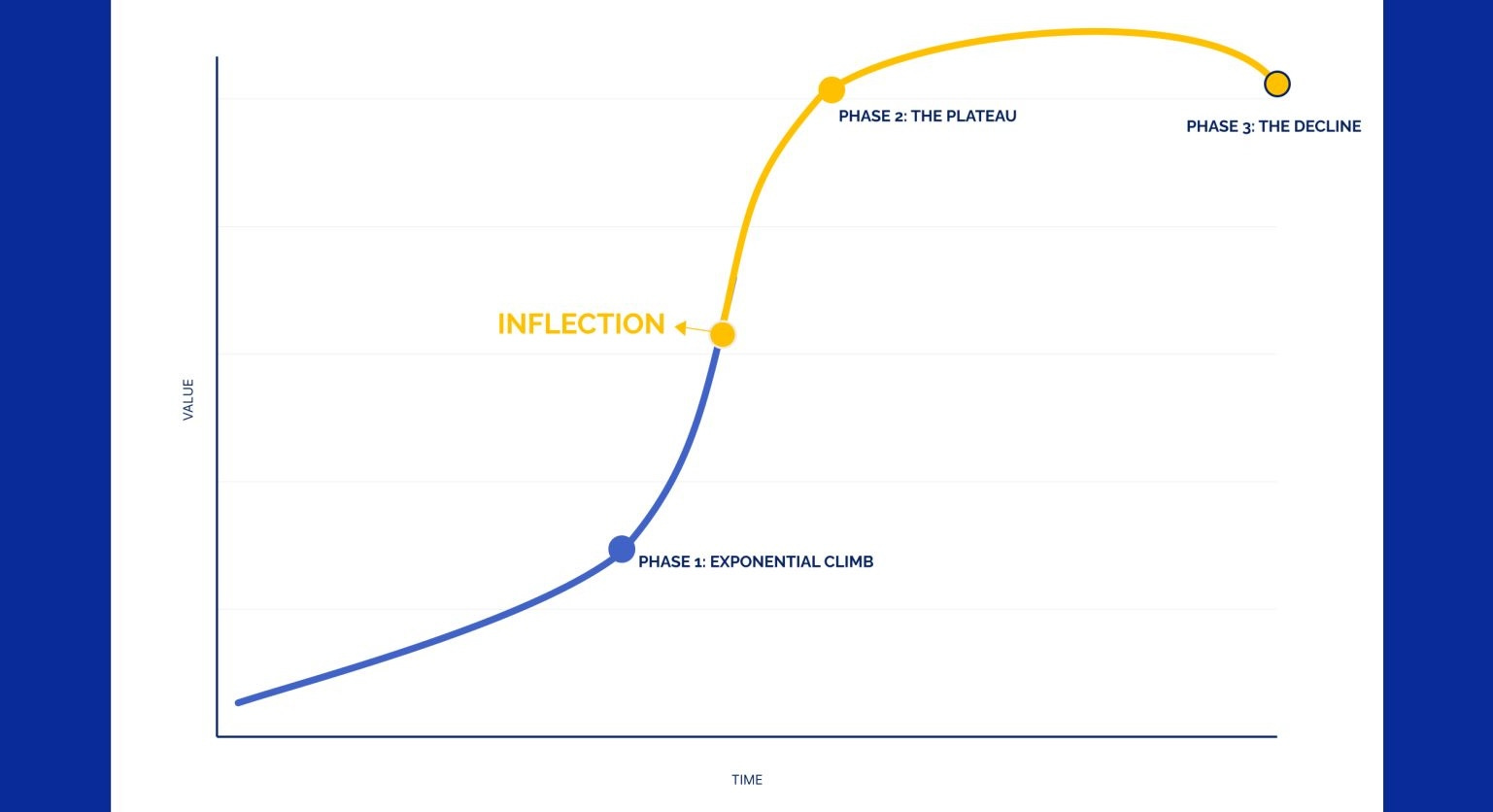
So just like technology, your narrative has a lifecycle. It moves through three distinct phases.
Phase 1: The Exponential Climb (Force Multiplier):
When a narrative is new, it creates disproportionate value. It differentiates you. It surprises people. The story travels without you having to push it. It reframes the world and opens a door to new possibilities. It creates massive lift and acceleration.
Phase 2: The Plateau (Functional Utility):
Over time, the market absorbs the narrative. It still works, but it no longer amplifies. Competitors sound like you. Buyers understand the category. Growth becomes incremental. You’re spending more energy to get the same result.
Phase 3: The Decline (Drag Co-efficient):
This is the real danger zone. At scale, the math turns against you. What once felt like momentum now feels like resistance. You’re selling into a saturated market with a story calibrated for a smaller world.
You tend to feel this in subtle ways. Meetings start to run longer. Decks get denser.
Growth requires more justification and less imagination. None of this looks like a messaging failure on the surface, but it often reflects narrative drag driven by the law of big numbers.
The “dip in the S-curve” is exactly where the CEO in my story was headed.
Their flagship offering had been in place for almost twenty years. It was safe, timeless, universally accepted…and somewhat static. It described what the company had always done, but it said nothing about where the world was going.
Meanwhile, AI and digital platforms were creating a new S-curve in their industry. And if they kept optimizing the old narrative while that new curve rose beneath them, there wasn’t going to be a graceful transition. There was going to be a collision.
Jumping the curve
The hardest part of leadership is not climbing the curve. It is recognizing when you have to leave it.
Whether you are moving from Product to Platform or from Seed to Series A, you are in a phase shift. The old story no longer creates the lift it once did, and the new one is not fully formed yet.
That in-between period is uncomfortable, and it is also necessary.
Once we separated hype from reality, I could help that CEO make the shift. We stopped describing the functional utility of the past and began articulating the aspirational value of the future.
Lately, I have been asking myself the same question, even when things are going well.
Is the story I am telling oriented toward where we have been, or toward where the world is going? Does our narrative expand the future, or does it quietly constrain it?
When things start to feel heavy, when explanation replaces enrollment, it is often a sign that you are nearing the end of the curve.
The goal is not to be right about the past.
It is to remain relevant for what comes next.
Michael
P.S.S. When you’re ready, here’s three ways I can help:
If you want a second set of eyes on your narrative, reply and tell me more
If you need narrative architecture, I help founders & operators do just that. Apply for Q2
If you want a storytelling keynote, I do them on a select basis. Let’s talk