


Every product is a mirror of the people who built it.
A computer scientist named Melvin Conway noticed this before almost anyone else.
In the late 1960s, while working as a programmer on some of the first large software systems in what would later become Silicon Valley, he identified a pattern others missed. The software teams built consistently mirrored the way those teams communicated.
Not sometimes.
Every time.
He turned that observation into a law.
And that law quietly changed how an entire industry thinks about execution.
I’ve been obsessed with Conway’s Law for years.
It’s the lens I use when I walk into any engagement, whether that’s advising a product org or sitting down with a founder to work through their narrative architecture. Let me break it down, because this is the part most people skip past without fully absorbing.
Conway’s Law: any software or tech product is a direct reflection of the communication structures of the organization that created it.
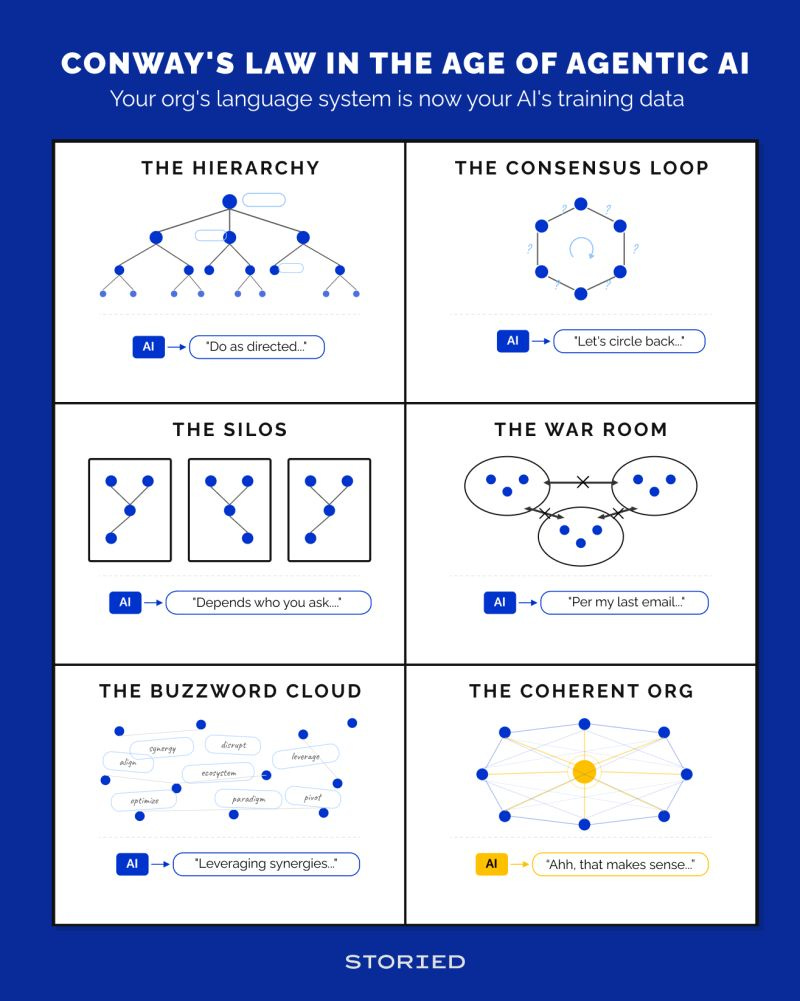
If your engineering team is organized into three groups that don’t communicate well, your software will have three distinct modules that don’t integrate well. If your product team and your sales team describe what you’re building in different language, your product will feel incoherent to the market. If leadership communicates in abstractions while the frontline operates in specifics, you’ll ship a product with a gap between vision and execution.
The boundaries of your system are held in the boundaries of your communication.
The strengths and limitations of any product reveal the strengths and limitations of the thinking behind it. We design systems that mirror the beliefs, assumptions, and constraints of the very culture that created them. That’s not a metaphor. It’s a law.
The shorthand people use for this is simple: you ship your org chart. Whether you mean to or not.
Three laws. One hidden constraint.
I keep placing Conway’s Law alongside two other laws.
Together, I think they form the real operating framework for anyone building at scale.
The first is the Power Law.
This is the math that governs venture capital returns. Across many bets over time, a small number will drive a disproportionate share of total returns, while many contribute in quieter but meaningful ways. The work becomes knowing where your energy can unlock exponential scale, and where steady support is the right move. Power Law dynamics are about asymmetry and compounding. How a few inflection points create outsized impact across an entire system.
The second is Moore’s Law.
First observed by Intel co-founder Gordon Moore, it describes how computing power compounds over time, doubling roughly every two years as costs fall. This steady acceleration is the tailwind behind each major technology wave of the last half century. Moore’s Law is about velocity. Not just how fast technology improves, but how quickly the frontier of what’s possible moves forward.
Power Law tells you where the returns are. Moore’s Law tells you when the technology is ready.
But neither one tells you whether you can actually execute.
That’s the gap. Both laws describe external conditions. Market dynamics. Technical capability. Neither accounts for the internal architecture. The human system. The context layer.
And the context layer is what we’re all struggling with right now, especially as everything keeps moving faster. Making sense. Creating meaning. Building shared understanding across teams, across functions, across an organization trying to move at the speed of compute.
The structures you put in place for that...the language, the narrative, the communication architecture. Those are the enabling functions for building anything at scale. Especially at hyper speed.
Conway’s Law is the hidden third law.
And right now, it’s the limiting factor on the other two.
Consider what’s happening in AI
OpenAI and Anthropic share closely related origins. A similar talent pool. Comparable starting conditions. The same moment in history. If you look only at Power Law and Moore’s Law, you’d expect broadly similar products.
And yet they feel different.
ChatGPT tends to be prescriptive and declarative. Here’s the answer. Next question. Claude is more reflective and consultative. It thinks out loud, acknowledges uncertainty, and asks clarifying questions.
This isn’t primarily a technology difference. It’s a Conway’s Law difference. The internal communication patterns at each company. What gets rewarded. How decisions get made. What kind of thinking is encouraged. Over time, those signals shape what gets built. Often unintentionally.
Two companies. Similar starting conditions. Meaningfully different products.
Why This Matters More Now
In an AI-first world, Conway’s Law matters more than ever. Not less.
AI systems amplify whatever language you feed it. When internal communication is misaligned, the outputs built on top of it tend to misalign as well. Your strategic docs, operating norms, and SOPs are increasingly treated as structured inputs that AI systems read and build on top of.
Narrative is no longer just how you communicate. It’s part of the architecture. The UX layer that shapes coherence, handoffs, and behavior downstream.
The question isn’t whether you have a narrative architecture. You always have one.
The question is whether it’s intentional, or chasing its tail.
A Simple Coherence Test
Pull up your org chart.
Notice where the boundaries sit between teams. Notice which groups talk regularly and which ones don’t. Now look at how your company shows up. Your product. Your go-to-market motion. Your customer journey.
The seams tend to line up. Disjointed products, inconsistent messaging, and leaky handoffs map to teams that don’t communicate well. Cohesive experiences, clear positioning, and smooth revenue motion map to teams that do.
Once you see it, you can’t unsee it. And once you see it, you can design for it. Not just better products, but better communication structures that make growth, alignment, and execution inevitable.
Run the test and the seams become hard to ignore. If something surprises you, I’m curious to hear what you notice.
Michael
P.S. With two kids under two, it’s hard to miss how much communication happens before language. Conway’s Law starts earlier than we think.