


Last week I wrote a LinkedIn post on Conway’s Law and it unexpectedly went viral.
The response was immediate. When you see it, you can’t unsee it.
You ship your org chart. Your product mirrors the communication structures that created it. People saw it instantly inside their own teams. In the roadmap. In the seams of the product. In the way decisions actually move.
Which raises a harder question.
What happens when we start layering AI directly into that same communication graph?
AI adds handoffs, not just horsepower
You don’t need to be deep in Claude Code or experimenting with multi-agent workflows to sense the shift.
The broader narrative is everywhere: AI is moving from assistant to actor.
In practical terms, that means systems that draft, analyze, route, trigger, and occasionally chain work together with less supervision. Instead of being a tool you consult, AI increasingly participates in the flow of work itself.
And once that happens, each system becomes another node in your communication network. It receives context, produces output, and hands that output to the next node, whether that’s a person or another system. Every additional node creates more handoffs, and every handoff is a place where meaning can get distorted.
I was working recently with a company that had doubled its headcount over a few years.
They had more specialization, better tooling, and more process discipline than ever before. Yet they were shipping at roughly the same pace they had when the team was half the size. It wasn’t intelligence or tools. What had grown fastest was coordination.
Project calls with 15 people where most were listening. Review cycles stacked three layers deep where one might have sufficed. Leadership eventually sent a note explaining that if you were only there to stay informed, recordings and summaries would suffice.
The meetings kept filling up anyway.
Because when people don’t trust that meaning will survive the handoff, they show up to hear it firsthand.
This coordination tax rarely appears as a line item. It shows up as subtle friction, calendar density, and the quiet anxiety that something important might get lost between teams.
Why your team doesn’t get 10x faster
At the individual level, AI can feel transformative.
A strong operator adopts good tooling and their output increases dramatically, sometimes 5x or more. The gains are tangible and hard to ignore. But when you zoom out to the team level, the picture shifts. The organization rarely moves 5x faster. Throughput may improve 10-15% percent. Occasionally more, but seldom in proportion to individual acceleration.
For a while, I couldn’t reconcile that gap.
Brooks’ Law helps explain it.
Decades ago, the software engineer Fred Brooks observed a pattern: every time you add a person to a team, you slow it down.
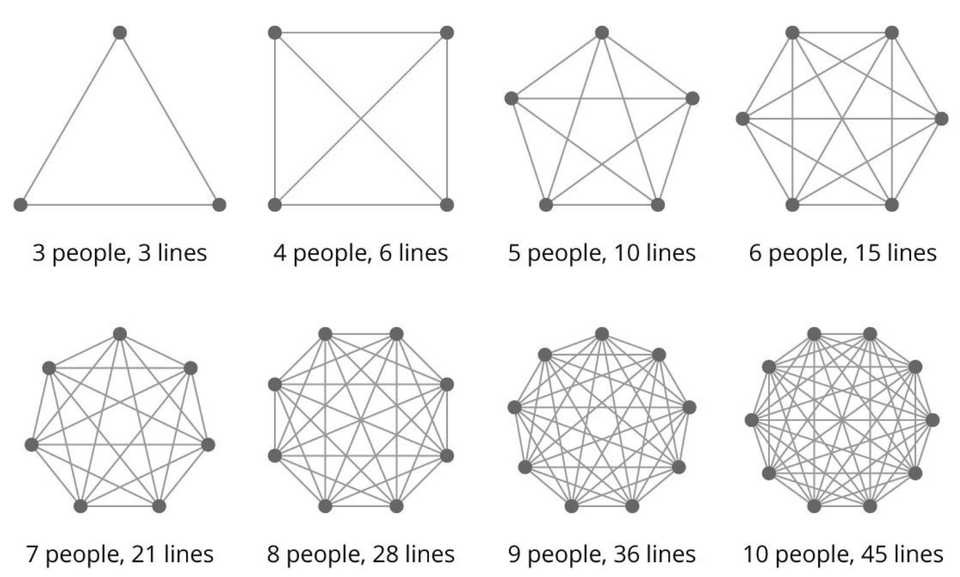
That reality doesn’t disappear just because some of the nodes are AI.
Each system can be highly productive on its own, but it still needs context and alignment within the broader workflow. Without a shared foundation, coordination grows quietly in the background, and much of the visible productivity gain gets absorbed into keeping everything coherent.
Most organizations track output improvements carefully. Very few track coordination cost with the same rigor. So AI looks impressive at the individual level, while at the organizational level strategic initiatives still feel slower than they should.
As a leader, you may sense the drag. It just doesn’t show up cleanly on any dashboard.
The hidden work nobody counts
The coordination tax is not abstract.
It’s built from specific, observable dynamics.Outputs that need to be reformatted when they cross a team boundary. Decisions that stall because two groups are using different language for the same priority. Subtle resets that occur when someone says, “That’s not what we meant,” and the workflow loops back to reinterpret assumptions.
If you’ve watched a capable team with good people and modern tools move more slowly than its talent would suggest, you’ve seen this at work. It’s rarely a question of intelligence. More often, it’s a question of coherence.
The teams that consistently move faster tend to share something deeper than tooling. They share language. A common way of framing tradeoffs. A shared understanding of what matters and how decisions are interpreted. An underlying architecture that allows meaning to travel across boundaries without being reconstructed each time.
When that architecture is present, coordination still exists, but it requires less repair.
I’ve seen small teams move with disproportionate speed because everyone could articulate the same priorities without checking in first. When they layered AI on top of that shared interpretive foundation, the outputs were aligned from the beginning.
Less translation. Fewer resets.
The coordination tax didn’t disappear entirely, but it stopped compounding at the same rate.
A quick way to spot your coordination tax
If you’re curious where the friction might be hiding, try mapping a single strategic initiative from end to end.
Count the handoff points, not just between people but between systems, teams, and decision layers. Each transition represents a coordination cost, whether visible or not.
Then ask two questions:
Which of these handoffs exist because your language isn’t aligned?
Which exist because the work genuinely requires distinct expertise or systems?
That distinction is often revealing.
In many cases, more handoffs exist than the work itself demands because meaning doesn’t reliably travel across the communication graph. When that happens, people compensate with more meetings, more reviews, and more context sharing.
Remember: AI will amplify whatever structure is already in place.
If interpretation is fragmented, it may amplify confusion and increase the repair work.
If interpretation is aligned, it can amplify clarity and reduce the need for constant translation.
The deeper question isn’t how many agents you deploy. It’s what kind of coherence you’re scaling as your graph grows.
P.S. I recently turned Tues into a zero-meeting build day. No calls, no handoffs, no alignment loops. Just deep work. I was so in the groove that I worked until midnight, which I never do. What struck me wasn’t the volume of output. It was how clearly it revealed how much of the other four days are spent maintaining coherence across the team. The tax is easy to miss when you’re inside the graph. It becomes visible the moment you step outside it.