


As a storyteller, I've always been more intuition than craft.
Both are really important.
Intuition is what lets me see the bigger picture and name the heart of the matter. I then take something complex and technical and translate it into what’s meaningful, or investable. That’s one aspect of my intuition...
Craft works differently for me.
I'm actually not a very mechanical person. I don't think in linear, step-by-step progressions. Which is why I hate a 10 min TED talk-type performance. Because that has to be scripted, and I’m wired for emergence. Real-time, conversational discourse that meets the moment. Socratic method.
My craft lives in principles: breaking things down to the fundamental irreducible truths. Applying that to the hardest problems to solve. And making that shine at a world-class standard. Whether a $100M fundraise, a category redefinition, or an AI transformation.
The point is, storytellers come in many shapes and sizes. AI just made the story generation the easy part. Which means there’s a new game to play.
If you want to master this shift, sign-up here for my live webinar “How to Go from Storyteller to Narrative Architect.” 305 registered so far. You’ll get the recording too.

You might not have "storyteller" in your title, but you tell stories for a living:
Chief of Staff who translates a CEO's vision into execution
Head of Comms with a sword and a shield, mostly defense, but also offense
Head of Marketing who has to translate ideas into go-to-market
Product, Data, or Eng Leader whose best work gets lost in translation
Expert or Advisor who sells what they know to companies in need
Whatever your title, the job is the same: get your idea funded, bought, or believed in by people with more power or influence than you.
AI now drafts a story in seconds, but it can't do the rest on its own. It doesn't know what you believe, it doesn't sound like you, and it doesn't speak the language of the CFO, the investor, or the product lead who has to say yes. Unless you train it how.
Run on intuition and craft alone, and you'll hit a wall with AI. Getting past it takes two things storytellers haven't needed before: (1) systems, meaning your thinking written down so AI can work from it, and (2) fluency in the languages of the people who decide.
Storyteller = intuition + craft
Narrative Architect = (intuition + craft + systems) × language fluency
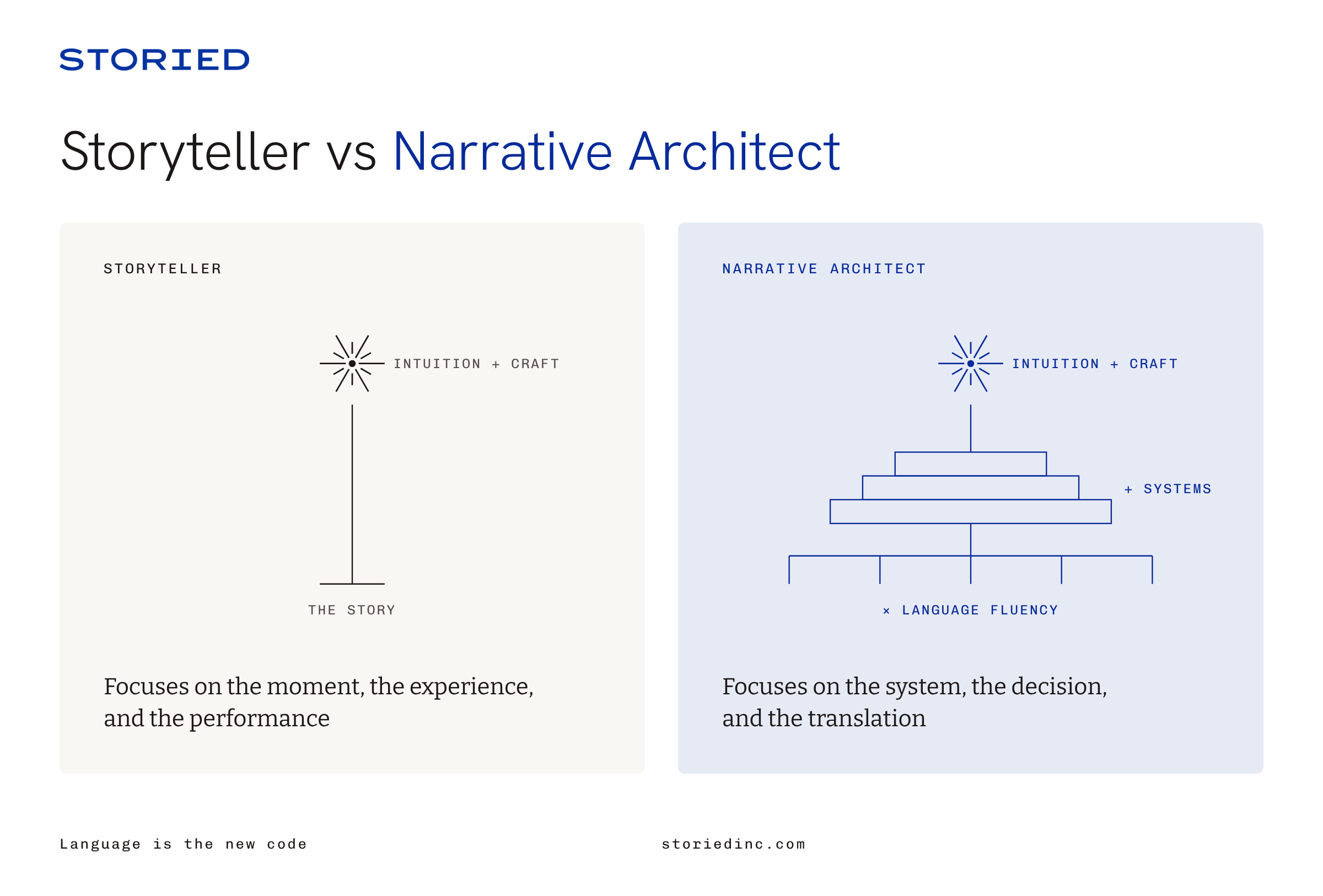
What Your AI Needs From You
AI is a machine built to systematize.
To systematize, you make what's implicit explicit by examining how you actually work, think, and perceive. AI can help you recognize the patterns. Then you sort, classify, and organize them so AI agents can serve as a true extension of you.
For a storyteller, that means writing down what you carry in your head: your worldview and first principles, a voice file for how you sound, how you make decisions, and the words that mean something specific in your world. Set it up on an architecture that's truly sovereign, so you keep ownership of your IP, your ideas, and your soul.
That's your Narrative Harness, from last week’s Substack.
Skip the harness, and your AI writes from the internet's idea of you.
Fluency Is the Multiplier
Decisions get made in someone's language.
A VC, a PE investor, and a public-company CFO all decide about money, and each runs a different thesis, underwrites differently, and prices risk differently.
Inside a company, it's the same. One of my biggest lessons from my seven years forward deployed inside Facebook was that execution lives or dies on XFN, cross-functional collaboration. Generative AI is collapsing those functions into each other: engineers are becoming marketers, and product people are becoming data scientists and builders, so the storyteller who can translate between those worlds is the one in the room when the decision gets made.
Fluency multiplies the way a network does: every language (audience) you add widens your surface area of influence.
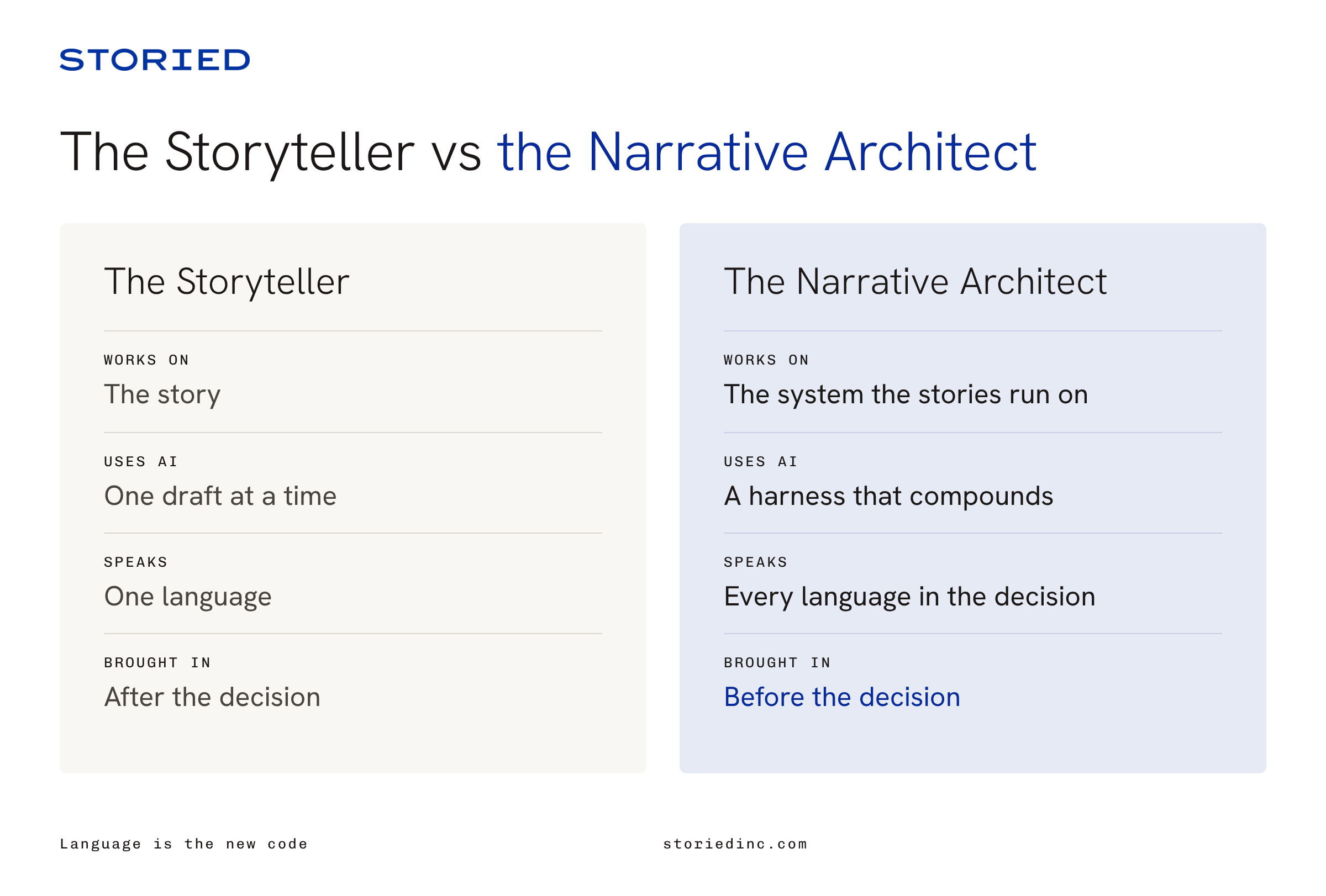
From Storyteller to Narrative Architect
I've come to see that intuition and craft aren't enough in 2026.
That’s not to say they don’t matter. In fact, they remain my languages of love. They’re the foundation of everything. But to scale with AI, you need systems and language fluency.
For some people that feels sacrilegious. Maybe you’d rather keep running on intuition and craft the way you always have. That’s totally cool. You do you.
I’m here for anyone that seeks the higher ground. You’re intrigued by the idea that your intuition and craft can be codified for AI. For more influence and leverage in your career. Without compromising your voice or integrity.
If you want guidance in that pursuit, join me for this Socratic session.
Intuition and craft got you here, and the languages you add decide where you go next.
LIVE WEBINAR THIS WEEK
From Storyteller to Narrative Architect
Hosted by Elliott Rayner
Thursday, November 12
9:00 AM PT / 12 PM ET / 6 PM CET
This is my first free public webinar in a good while. I'm pulling back the curtain on how to drive decisions at the executive / board room level. In 45 minutes, you'll see how to translate your storytelling instincts into systems your AI can run, how to work with language as a code base, and three steps to strengthen your influence as a new kind of storyteller.
More than 300 people have already signed-up. It's free and recorded.
Save your seat and watch when it suits you.
Michael
P.S. Want to become a Certified Narrative Architect? More on that soon…